
Blackout Blinds for Large Windows in Black: Science, Functionality, and Practical Use
Blackout blinds have become an essential component for both residential and commercial spaces, especially for large windows, where controlling light, temperature, and privacy presents a significant challenge. Choosing blackout blinds in black combines aesthetic appeal with scientifically proven functionality. While they are often described in simple terms as “light-blocking,” the underlying technology and materials used in these blinds are far more sophisticated. In this article, we provide a comprehensive, scientific analysis of how black blackout blinds work, their materials, and optimal usage for large windows.
1. Understanding the Physics of Blackout Blinds
Choose curtain cloth to cover UNITEC room!
At the core of any blackout blind is the principle of light control. Blackout blinds aim to minimize or completely prevent the transmission of visible light through windows. The science behind this involves three main phenomena:
Absorption – The black pigments used in the blind’s fabric absorb incoming light energy. Carbon black, a common additive in premium blinds, is highly effective in absorbing visible light, converting it into a negligible amount of heat.
Reflection Suppression – Unlike lighter-colored blinds, black surfaces reduce internal reflection. When light strikes a black surface, it is mostly absorbed rather than scattered, which ensures minimal light penetration.
Diffusion and Layering – High-quality blackout blinds for large windows often use multiple fabric layers. Each layer scatters any residual photons, creating a near-total barrier. Multi-layer construction also improves thermal insulation and sound absorption.
These combined effects explain why black blackout blinds are highly effective even against direct sunlight.
Collection of fabrics to darken the UNITEC window
Code:DP14PRO-2300~2320
Style:Blackout
Application:Drapery/Curtain(IndoorUseOnly)
Composition:100%Polyesterwithacryliccoated
Width:280cm
RollLength:50mts±10%
Weaving:Jacquard
Thickness:0.35mm±10%
Weight:235±5%gsm
ColorFastness:Grade7-8
UVBlockage:100%
Certification:SGS,Oeko-Tex100,Intertek,ISO9001
AvailableCustomizationFeatures:FR,Antibacterial,Color.China DP14PRO-2300~2320 factory and manufacturers | UNITEC

2. Materials and Structure of Blackout Blinds
a) Base Fabric
Most modern blackout blinds use polyester-based textiles. Polyester offers dimensional stability, high tensile strength, and resistance to stretching. For large windows, where the fabric spans wide areas, this mechanical stability prevents sagging and deformation over time.
b) Opacifying Coating
To achieve full light blockage, the fabric is coated with acrylic or PVC layers, sometimes pigmented with carbon black. These coatings perform several functions:
Increase opacity, ensuring near 100% light blockage
Improve UV resistance, protecting interiors from sun damage
Enhance thermal insulation, reducing heat transfer through windows
c) Multi-layer Construction
High-performance blackout blinds often include two or three layers: a base textile, a blackout coating, and a protective top layer. This layering ensures uniform color, prevents light leakage at the edges, and adds structural strength necessary for large installations.
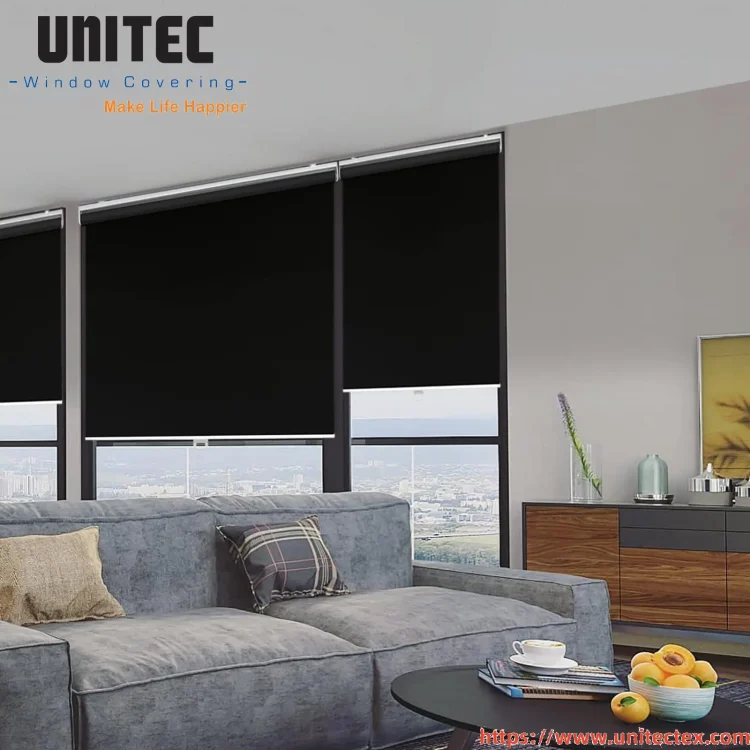
3. Thermal and Acoustic Benefits
For large windows, the functional benefits of blackout blinds extend beyond light control:
Thermal insulation: The coated layers reduce heat gain in summer and heat loss in winter. For large glass areas, this translates to measurable energy savings.
Acoustic damping: The dense, layered fabric can reduce sound transmission by absorbing mid- and high-frequency noise. This is particularly useful for urban apartments, offices, and conference rooms.
Both effects are directly related to material density and thickness. For example, a 0.5mm thick acrylic-coated polyester fabric can reduce heat transfer significantly while maintaining smooth roll-up operation.
4. Practical Considerations for Large Windows
Installing blackout blinds for large windows presents unique challenges that require both technical knowledge and careful planning:
a) Roll Mechanism and Weight Support
Large blinds are heavier due to their size and fabric layers. Modern solutions use reinforced roller tubes, motorized mechanisms, or heavy-duty chain drives to ensure smooth operation without sagging.
b) Edge Sealing and Light Gaps
Even high-quality blackout fabric can allow light leakage at the sides. For large windows, side channels, magnets, or velcro strips are often used to eliminate gaps, ensuring complete darkness when required.
c) Fabric Maintenance
Acrylic-coated polyester is resistant to moisture and dust, but regular cleaning maintains opacity and appearance. For motorized large blinds, automated light-cycle programs can help reduce wear and prolong life.
d) Mounting Options
Ceiling-mounted: Ideal for floor-to-ceiling windows; allows full window coverage and smooth roll-up.
Wall-mounted: Suited for large office or commercial windows; ensures alignment with window frames.
Recessed installation: Provides a seamless, minimalistic appearance while maximizing light control.
5. Optimal Usage Scenarios
Blackout blinds in black are particularly effective for:
Home theaters and media rooms: Provides a cinema-like environment by blocking nearly 100% of light.
Bedrooms with morning sunlight: Prevents early wake-ups due to sunlight, enhancing sleep quality.
Conference rooms and offices: Reduces glare on screens while improving privacy.
Hotels and hospitality spaces: Ensures consistent darkness for guests, enhancing comfort.
In each scenario, large windows pose challenges of light leakage, weight, and thermal transfer, all of which are mitigated by scientifically designed blackout fabrics and mechanisms.


