
Fiberglass vs Polyester Sunscreen Fabric: A Buyer’s Selection Guide
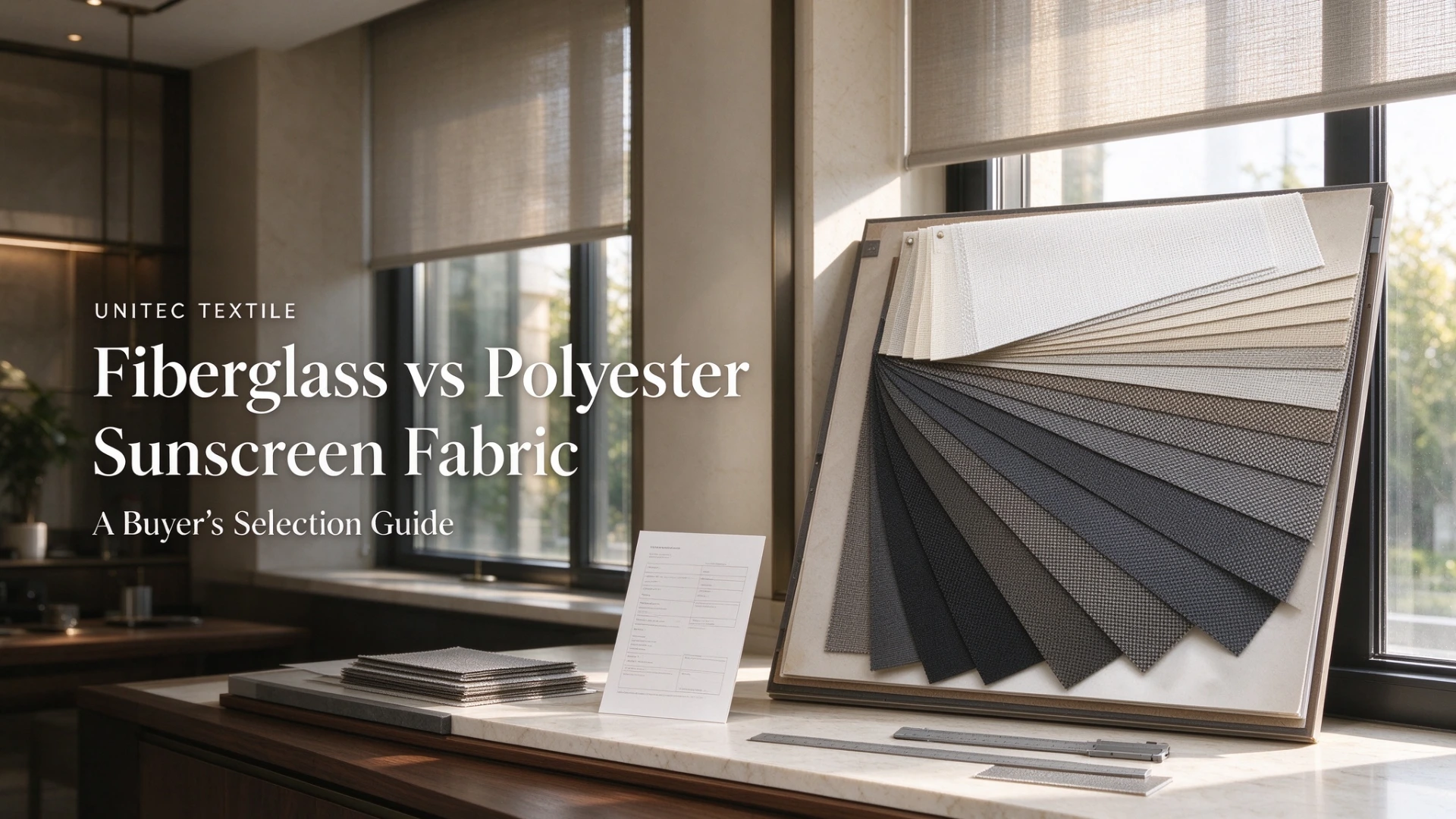
The buyer answer
Neither construction is universally better.
Fiberglass-core PVC sunscreen fabric and polyester-core PVC sunscreen fabric can both be appropriate for roller shades. The right choice depends on the selected construction, openness, colour, coating, finished shade dimensions, operating system and the verified performance required by the project.
The practical question is not simply “fiberglass or polyester?” It is: “Which specific fabric construction has the verified data, dimensions, documentation and supply fit for this program?”
Construction first
Compare complete sunscreen fabric constructions
A sunscreen fabric is a finished technical material. Its performance comes from the combined effect of its yarn core, PVC coating, weave geometry, openness factor, colour and finishing—not from the core fibre alone.
| Comparison point | Fiberglass-core PVC sunscreen fabric | Polyester-core PVC sunscreen fabric | What a buyer should verify |
|---|---|---|---|
| Construction | Fiberglass yarn reinforced and PVC coated. | Polyester yarn reinforced and PVC coated. | Exact composition, coating system, weave and selected model—not only the generic material category. |
| Dimensional behaviour | Must be assessed on the selected fabric and finished-shade application. | Must be assessed on the selected fabric and finished-shade application. | Dimensional-stability test method, result, test conditions and shade-size recommendation. |
| Mechanical performance | Cannot be concluded from fibre type alone. | Cannot be concluded from fibre type alone. | Warp/weft tensile strength, elongation and tear resistance using stated methods. |
| View, glare and solar control | Depend on openness, colour, coating and fabric geometry. | Depend on openness, colour, coating and fabric geometry. | Colour-specific optical or solar data, with the test basis clearly identified. |
| Commercial fit | Evaluate available widths, documentation and total usable cost. | Evaluate available widths, documentation and total usable cost. | MOQ, lead time, repeat-order consistency, customisation and claim-handling process. |
A comparison is meaningful only when the competing fabrics are tested and specified on a like-for-like basis.
Selection logic
How to choose the right sunscreen fabric for your program
Buyer verification
What to request before approving a sunscreen fabric
A good buying decision is supported by documents that match the exact fabric model, colour, width and configuration under review.
- Product data sheet showing composition, openness, width, mass, thickness and roll length.
- Warp and weft tensile strength and elongation data, with the stated test method.
- Tear-resistance data where the application or customer specification requires it.
- Dimensional-stability information with heat, humidity or loading conditions stated.
- Colour-specific optical or solar data when visual comfort, glare or energy performance matters.
- Applicable fire, emissions and chemical-compliance documents for the selected construction.
- Full-width sample evaluation on the intended tube, hardware and finished-shade dimensions.
- Commercial confirmation of MOQ, lead time, available widths, custom colours and repeat-order support.
- Strength and elongationISO 1421 or ASTM D751 may be used, depending on the agreed specification and test laboratory.
- Tear resistanceISO 4674-1 or another agreed method should be named together with the actual test result.
- Mass and thicknessISO 2286-2 and ISO 2286-3 are examples of methods used for coated-fabric properties.
- Optical and solar propertiesConfirm whether reported values describe the fabric alone or a complete glazing-and-shade system. These are not interchangeable.
UNITEC sunscreen fabric options
Start with a construction that fits the brief
The figures below identify selected UNITEC series. They are model-specific reference data, not a universal performance ranking between fiberglass and polyester constructions.
Fiberglass-core PVC sunscreen fabric
| UNITEC series | Openness | Composition | Available widths | Weight | Thickness |
|---|---|---|---|---|---|
| URFS-1 | 1% | 37% Fiberglass / 63% PVC | 1.6 m, 2.0 m, 2.5 m, 3.0 m, 3.2 m | 570 gsm ±5% | 0.71 mm ±10% |
| URFS-3 | 3% | 37% Fiberglass / 63% PVC | 1.6 m, 2.0 m, 2.5 m, 3.0 m, 3.2 m | 560 gsm ±5% | 0.70 mm ±10% |
| URFS-5 | 5% | 37% Fiberglass / 63% PVC | 1.6 m, 2.0 m, 2.5 m, 3.0 m, 3.2 m | 480 gsm ±5% | 0.67 mm ±10% |
Polyester-core PVC sunscreen fabric
| UNITEC series | Openness | Composition | Available widths | Weight | Thickness |
|---|---|---|---|---|---|
| URS1200-PRO | 0.5% | 30% Polyester / 70% PVC | 2.0 m, 2.5 m, 3.0 m | 543 gsm ±5% | 0.72 mm ±10% |
| URS1200 | 1% | 30% Polyester / 70% PVC | 2.0 m, 2.5 m, 3.0 m, 3.2 m | 496 gsm ±5% | 0.72 mm ±10% |
| URS1500 | 3% | 30% Polyester / 70% PVC | 2.0 m, 2.5 m, 3.0 m, 3.2 m | 450 gsm ±5% | 0.61 mm ±10% |
| URS300 | 5% | 30% Polyester / 70% PVC | 2.0 m, 2.5 m, 3.0 m, 3.2 m | 419 gsm ±5% | 0.55 mm ±10% |
Documentation and configuration support
All UNITEC sunscreen fabrics are SGS certified. UNITEC confirms certification coverage for colours, widths and customised configurations. Final project approval should still be based on the selected model’s current technical documents, required test scope and intended application.
Specifications, available colours, widths, customisation, supply availability, MOQ and lead time must be confirmed for the selected series before purchase approval.
Frequently asked questions
Fiberglass vs polyester sunscreen fabric FAQs
Is fiberglass sunscreen fabric always more stable than polyester sunscreen fabric?
Is polyester sunscreen fabric suitable for roller blinds?
Does a lower openness factor automatically provide better solar or UV performance?
Which test data should a sunscreen fabric buyer request?
Can I compare fiberglass and polyester sunscreen fabrics by weight alone?
What documents should be checked for a commercial project?
Continue your research
Related Technical Guides
- Sunscreen Fabric Selection Guide — choose openness, colour, performance priorities and project fit.
- How to Choose Openness Factor for Roller Blind Fabrics — compare privacy, view, glare control and daylight trade-offs.
- Explore UNITEC Sunscreen Fabrics — review available openness options and request samples.
This Fiberglass vs Polyester Sunscreen Fabric Selection Guide provides general selection support only. Actual performance, documentation, supply availability, customization, MOQ, lead time and commercial terms must be confirmed for the selected model, colour, width and configuration before approval or purchase.
Choose with evidence
Need help selecting the right sunscreen fabric construction?
Send UNITEC your target application, finished shade dimensions, preferred openness, required width, colours, compliance needs and estimated volume. We will recommend suitable series and identify the data that should be verified before approval.