Roller Blind Fabric Selection
How to Choose Openness Factor for Roller Blind Fabrics
Openness factor is a useful starting point for selecting sunscreen roller blind fabric. It helps buyers compare the balance between daylight, outward view and visual screening—but it is not a complete performance rating on its own.
Start with the right definition
What Does Openness Factor Mean?
Openness factor describes the proportion of open area in a screen fabric. A lower percentage generally means a tighter construction, while a higher percentage generally creates a more open screen.
However, openness factor does not by itself define total visible-light transmission, UV performance, solar heat performance, glare control or privacy. Those results can change with the fabric construction, yarn and coating system, colour, glazing, installation position and complete blind system.
Do not compare openness alone.
For meaningful supplier or project comparisons, check the selected model, colour, technical data, documentation scope and sample performance—not only the nominal percentage.
A practical starting point
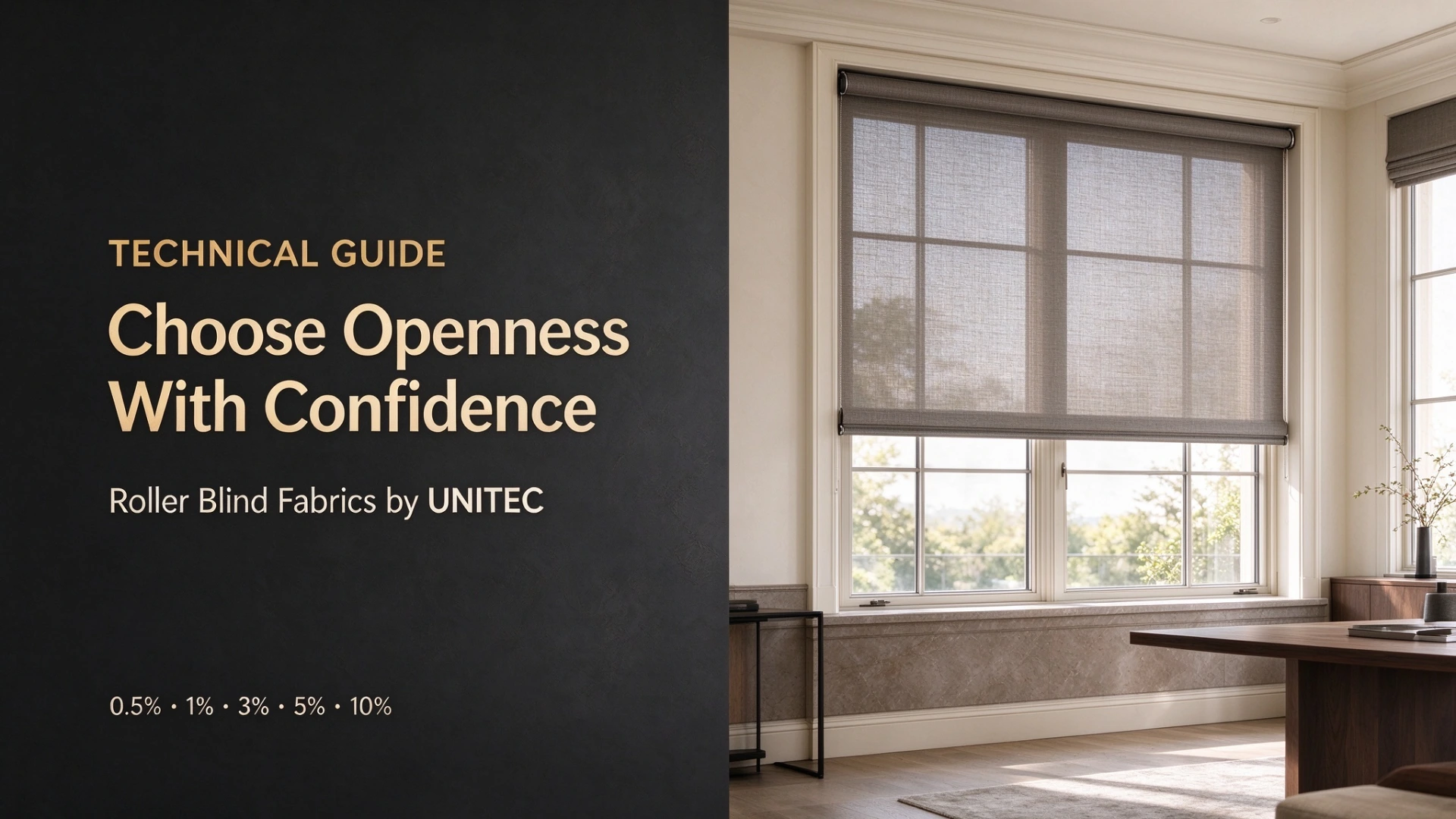
Compare 0.5%, 1%, 3%, 5% and 10% Openness
The table below helps buyers build an initial shortlist. It describes relative selection roles for broadly comparable screen fabrics; it is not a laboratory classification or a guarantee of project performance.
| Openness | Typical Selection Role | View and Daylight | Glare and Screening Considerations | Buyer Cautions |
|---|---|---|---|---|
0.5% | High-control starting point for demanding daylight and glare conditions. | More restricted direct view and daylight than more open comparable screens. | A tighter screen can be considered where closer visual control is needed. UNITEC offers 0.5% options in the URS1201 Pro–URS1206 Pro range. | Not blackout and not a promise of nighttime privacy. Confirm the selected colour, fabric construction and application conditions. |
1% | Control-first option where glare management and daytime screening are important. | Usually offers a more filtered outward view than more open comparable fabrics. | Often considered for glare-sensitive interiors, subject to colour, façade exposure and workstation position. | Do not calculate UV performance as “99%” from the openness figure alone. |
3% | Balanced commercial option between visual control, daylight and outward view. | Generally offers more visual openness than 0.5% or 1% comparable screens. | A practical starting point for many offices, classrooms and mixed-use interiors. | Monitor comfort still depends on sun angle, glazing, colour and the complete blind system. |
5% | View-and-daylight option for collections that need a more open visual connection. | Generally allows a more open outward view and greater daylight passage than tighter comparable screens. | May suit moderate exposure or spaces where visual connection is a stronger priority. | Not automatically suitable for every office façade, direct-sun condition or privacy-sensitive application. |
10% | View-first option for selective, lower-control or supplementary-shading applications. | Usually provides the most open view and daylight among these comparable options. | Less restrictive of direct sunlight and bright-sky exposure than tighter screens. | Assess glare, screen use and privacy carefully. A high openness percentage is not a universal solution for north-, south-, east- or west-facing façades. |
Relative trends assume comparable fabric construction, colour and viewing conditions. Actual performance must be assessed for the selected model, colour, glazing and installation system.
A common sourcing mistake
Open Area Is Not the Same as Light, UV or Heat Performance
Openness is not visible-light transmission
The open area percentage does not tell you the complete amount or quality of visible light passing through a fabric.
Openness is not a UV test result
UV performance should be supported by the selected product, colour, test method and report scope. It should not be calculated from openness.
Fabric data is not whole-system data
Glass type, installation position and the blind system influence thermal results. Project calculations require the relevant system assumptions.
Visual comfort
Choose Fabric Colour Together with Openness
A dark screen fabric generally improves outward-view contrast and can help reduce the visible brightness of the fabric surface. A light screen fabric can create a brighter interior appearance and may provide different reflection characteristics. Neither is universally better.
Mid-tones, mixed yarns, dual-sided constructions and special coatings should be evaluated by their actual optical data and sample performance—not by colour name alone.
Best practice for collection approval:
Review dark, light and mid-tone samples at the window, under the expected viewing direction and at the time of day when glare or privacy is most important.
Privacy and complete-system performance
Daytime Screening Is Not Nighttime Privacy
During the day, a screen fabric may provide useful visual screening when outdoor conditions are brighter than the interior. At night, interior lighting can reverse that relationship. A screen that allows outward view should not be presented as a guaranteed nighttime privacy solution.
Where nighttime privacy or stronger room darkening is required, buyers should consider a separate blackout roller blind, a dual-roller system, curtains or another suitable window-covering treatment.
Why installation still matters
Side gaps, blind position, guide systems and window geometry affect the finished result. Side channels can help address peripheral light gaps, but they do not change the openness of the screen fabric itself.
Explore roller blind fabric options →B2B collection planning
Build a Practical Openness-Factor Collection
Start with demand, not symmetry
Do not stock every colour in every openness option simply to create a complete-looking range. Define the core range around your customer segments, applications and repeat demand.
Give each option a clear purpose
Use tighter options for control-led requirements, balanced options for broad commercial use and more open options where daylight and view are stronger priorities.
Compare documented differences
Differentiate adjacent products through construction, colour range, width, fabrication suitability and supporting documentation—not only by a percentage label.
Before sample approval or bulk ordering
What B2B Buyers Should Confirm
Use the following checklist before finalising a roller blind fabric program, a sample book or a project material approval.
- Destination market and end-use application
- Façade orientation and direct-sun exposure
- Priority: glare, view, daylight, privacy or thermal management
- Selected openness factor and colour direction
- Fabric construction, width and fabrication requirements
- Glass type and installation system, where relevant
- Required test reports, certifications or tender documents
- Sample review under actual project conditions
Frequently asked questions
Roller Blind Fabric Openness Factor FAQs
What does 5% openness mean in roller blind fabric?
What is the difference between 0.5%, 1%, 3%, 5% and 10% openness?
Is 1% openness fabric blackout?
Do sunscreen roller blinds provide nighttime privacy?
Do dark or light sunscreen fabrics provide a better view?
Which technical information should buyers request before ordering?
Plan with the right information
Discuss Your Sunscreen Fabric Collection
UNITEC supports importers, distributors, finished blind manufacturers and project buyers with fabric selection, sample review, technical information and collection-planning support.
This Roller Blind Fabric Openness Factor Guide provides general selection support only. Actual performance, documentation, supply availability, customization, MOQ, lead time and commercial terms must be confirmed for the selected model, colour, width and configuration before approval or purchase.